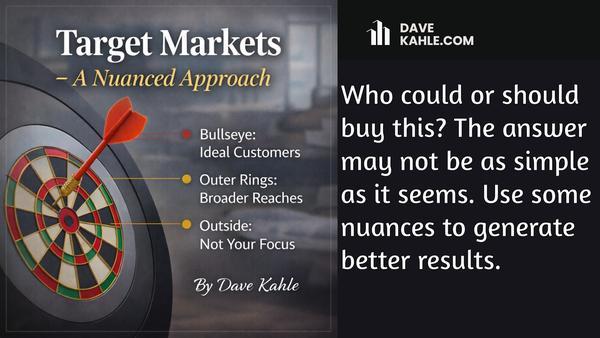
Who could or should buy this? That’s one of the biggest decisions a business makes when contemplating something new — a new product, a new branch, a new business. In other words, for which what target market is this designed?
Approach it by asking these questions:
* How do I describe those who are most likely to need/want what I have?
* Who needs or wants what I have?
* Who can pay for it?
* Are there enough of them to make it worth my time?
Target market is a term that describes a group of suspects and prospects who meet the criteria contained in the questions above, and have something in common. When referring to individual consumers, that thing in common could be demographics, like “men between the ages of 30 – 50.” Or, it could be psychographics, like “enjoy spending
time with others;” or socio-economic level, like “earns between $70,000 and $90,000 annually;” or geography, as in “Iives in telephone area code 940”
The process works for B2B marketing as well. A target markets can be defined as “Manufactures with 300 -500 employees, who are eager for growth, and have headquarters in the
state of Florida,” for example.
Regardless of the general class of prospects – consumers or B2B — there are two principles that impact the quality of these decisions:
1. The more precisely you define your target market, the easier it is to market to it.
2. There are layers of suitability for your definition of target markets.
Let’s look at each.
1. The more precisely you define your target market, the easier it is to market to it.
Let’s say that you are a mechanic with an auto repair shop. You could say your market is “Anyone who owns a car that needs repair or
maintenance.”
You could break that down into more precise, narrower market segments. For example, you could define your market as “owners of Ford products,” That describes a market which is smaller and more precise than the first
description.