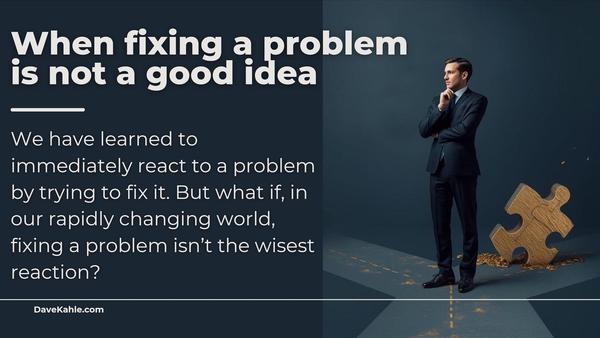
When we are
confronted with a problem, our knee-jerk reaction is to fix it. I’m not talking about common day-to-day problems – a faucet begins to leak, we run out of milk, etc.—but rather significant business and career issues. These are problems that have a significant impact on our businesses or our careers. So, for example, our basic software system keeps crashing, we lose a key employee, a key vendor closes their doors, or our boss is replaced with someone who rubs us the wrong way.
In each of these and similar problems, our instinctual reaction is to fix it. In other words, to restore the status quo – to return the situation to a state as close to what it was previously as possible. So, if a key employee leaves, we immediately seek to replace him/her.
But what if there were a more effective approach to the situation? Suppose we looked at every problem/objecive as an opportunity to put somethng better in place?
To simply replace a person, a policy, proceeedure or bit of hardware or software that was acquired years ago may have been OK some time ago, but today it represents an opportunity to make a strategic improvement.
Our world today is changing faster than at any time in human history. If we are going to be successful in this new environment, we need to take on some new attitudes, new skills, and a mindset that says to maintain the status que is
to fall behind. Every crises, every significant problem and every major maintance action is an opportunity to create a more powerful, strategically motivated outcome – something I call a “Leap Forward’.